Mobile app development people keep on the home screen.
One app for iPhone and Android, published in both stores by us, and updated afterwards without anyone holding their breath.
Why app projects usually stall.
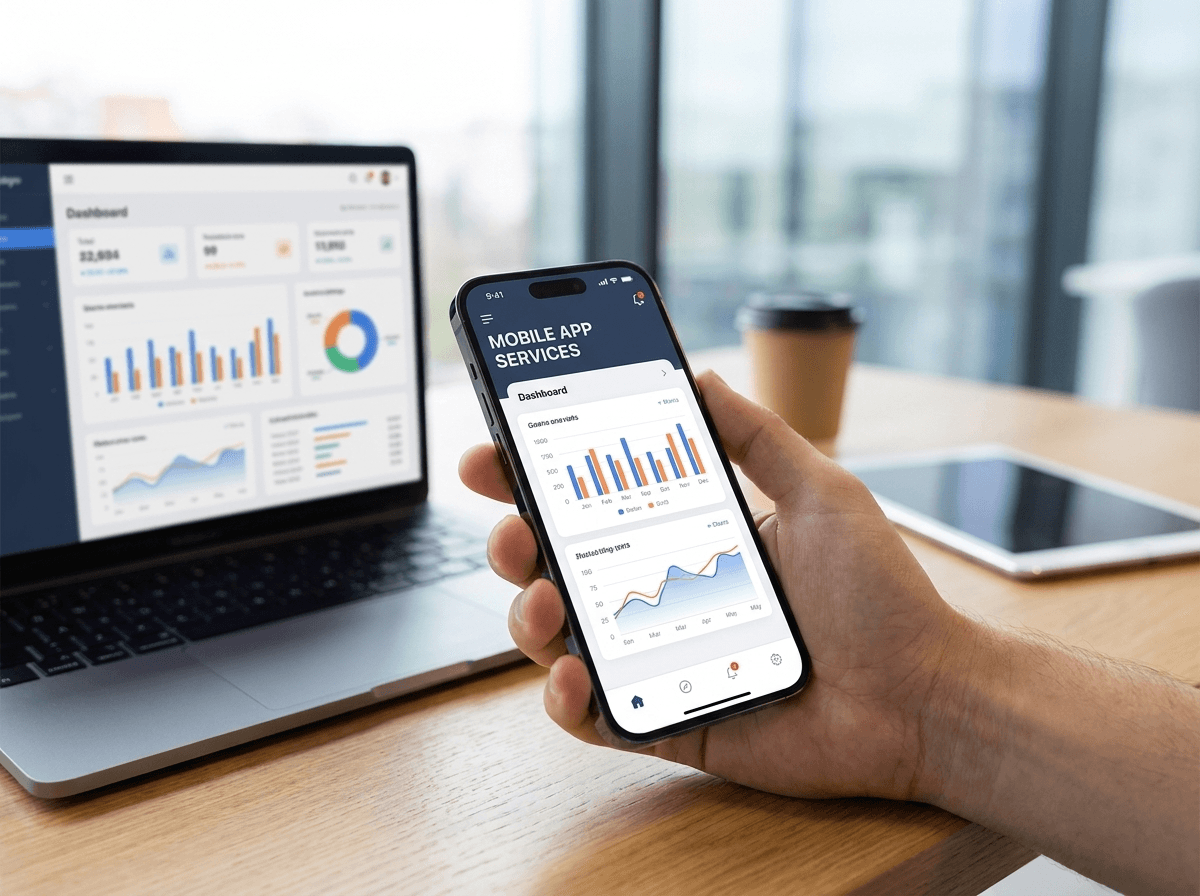
From change to their phone, in five days.
How updates reach people is half the job. Hover a stage to see what happens there — and what cannot go wrong.
The work is checked automatically.
Before a change can go anywhere, it is tested on its own. Something broken never reaches a phone, so nobody loses an afternoon working out which change caused it.
Anything found here never becomes a problem for the rest.
Everything between the idea and their phone.
Design, build, getting it into the stores, and everything after — open any line to see what that means.
The one job people will open it to do, the screens that get them there, and an honest list of what we are leaving out of the first version so it can launch this year.
It behaves the way an iPhone is supposed to behave, and the way an Android is supposed to behave — including what it shows when something is loading, empty or has gone wrong.
One app that runs on both, so you are not paying two teams to build the same thing twice. Where the phone itself matters — camera, maps, background work — we go deeper for that part only.
Signing in, subscriptions, buying inside the app and notifications that actually arrive — connected to whatever you already run behind the scenes.
Publishing to the App Store and Google Play is ours: Apple's and Google's paperwork, the privacy forms, the screenshots and the reply when a reviewer asks a question. The accounts stay in your name.
We can see if it crashes and where people give up, small fixes reach everyone without them downloading anything, and you get a ranked list of what to do next.
What people ask us first.
Something not covered? Ask us directly — you will get a straight answer, not a brochure.
No. We build one app that runs on both, which is why it costs roughly what one app costs rather than two. Only the parts that really depend on the phone itself — heavy camera work, for example — get built separately, and we tell you up front if your idea needs that.
We do. The certificates, the privacy forms, the screenshots, and the reply when a reviewer asks a question. The store accounts are opened in your name and stay yours, so you are never locked out of your own app.
We look at it first. Quite often three releases fix what you have and a rebuild is a waste of money. When rebuilding genuinely costs less than carrying on, we show you the arithmetic before we suggest it.
Small fixes reach everyone within hours without them downloading anything. Bigger changes go out to a small share of users first, and only widen when the numbers hold — so a bad release reaches a handful of people instead of all of them.
If the job needs it, yes — and we decide that early, because adding it to a finished app is the expensive way round. What is stored on the phone, what waits to be sent, and what wins if two people changed the same thing.
Everything, from the first day. The code, the store accounts, the signing keys, the servers. We work inside accounts that are already yours, so there is nothing to hand back later.
Ready to ship your app?
Tell us what the app should do and who it is for. You get a plan, a launch date and what it costs, in writing, within two working days.